
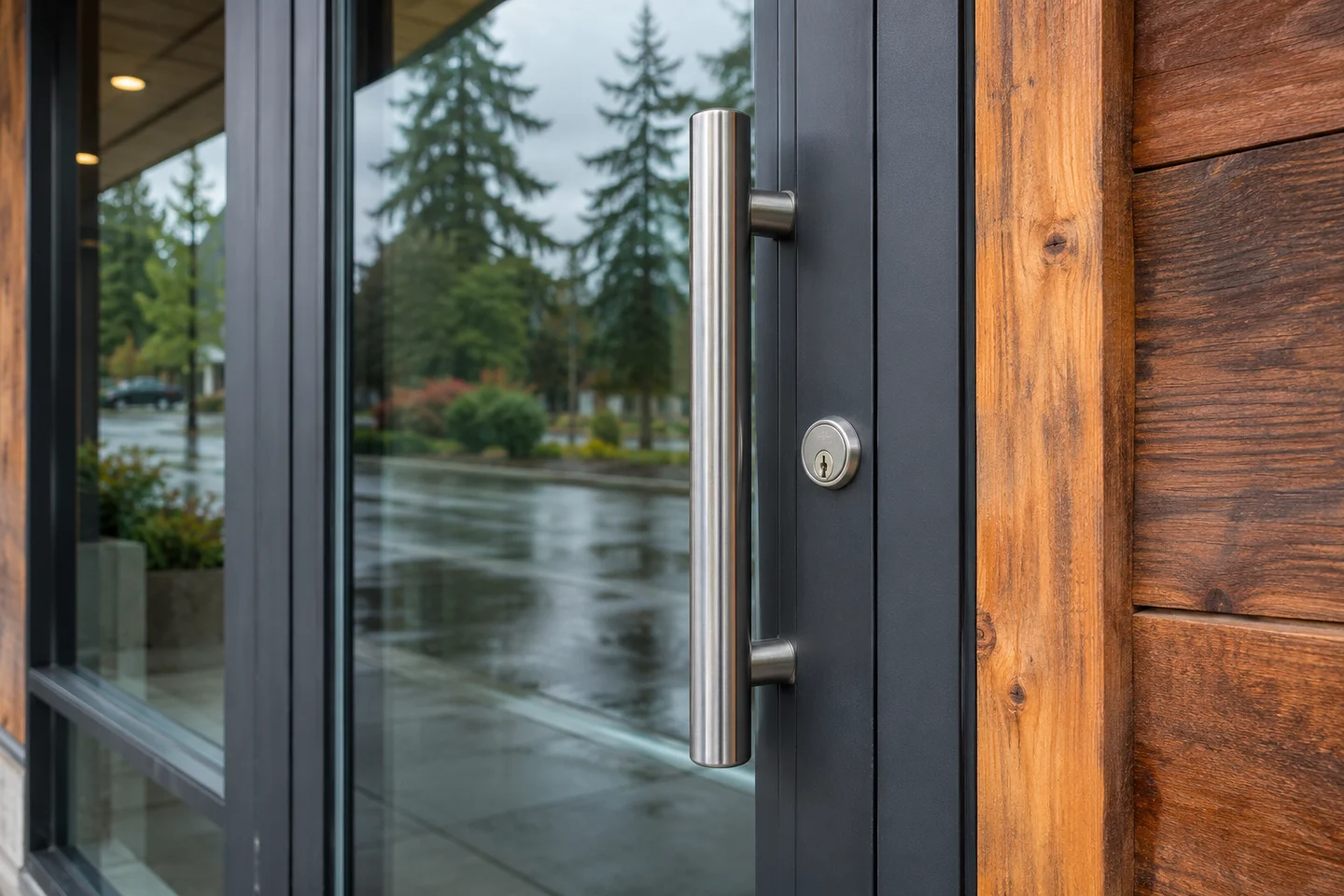
Start with the key list.
Write down which doors a staff key opens and who should still have access. A missing key to a stockroom has a different reach from one that also opens the main entrance. That small list helps keep the work focused.
A suite is not the whole building.
Along International Boulevard, a street address may lead to several businesses. Give the suite and identify the public, staff or internal door involved. Confirm whether you, the property manager or the building owner can authorize changes.
Access and door operation are separate.
A new key combination can remove old mechanical-key access. It will not correct a latch that misses the strike or a handle that has worked loose. Explain any closing or exit problem before choosing replacement hardware.
Specialist systems need a specific conversation.
If the opening uses electronic access, an exit device or a restricted key system, describe it and share its identification where available. Confirm the equipment and work supported for that door. This website does not establish access to airport facilities or a service agreement with any hotel or business.
Staff turnover is a key-control question.
Collecting a departing employee's key does not establish whether copies exist. Start with the doors that key operated and the access the current team needs. A single stockroom, a shared front entrance and a set of internal offices may call for different changes.
Keep a record of the keys issued after the work. If keys form part of a master-key or restricted system, involve the person who manages it before changing a cylinder. An isolated alteration can leave the wider access plan unclear.
A door that locks still has to work for people.
A public entrance has to open, close and latch as intended. Mention a closer that slams, a latch that misses or an exit device that feels wrong. Those symptoms are useful even if the reason for your call was a missing key.
Hardware used for exit or controlled access needs an appropriate assessment. Do not add an improvised lock or block a door to compensate for a fault. Describe the existing equipment so the right scope and equipment support can be confirmed.
Make a quote specific to the opening.
A useful description names the door, the cylinders or components involved, the keys supplied and any follow-up work. Clarify who will approve changes if a different fault is found. For a small office move, the access checklist is also a useful starting point for codes and remotes that a mechanical rekey will not change.